
The warehouse sends a screenshot full of red, amber and green cells. Your colleague forwards it with one question: “Which orders need us to make a decision?” The colors may look informative, but they have not necessarily made the work easier to understand.
Service reporting is part of the relationship you buy from a 3PL. Its value depends on whether the people using it can find the information and act without asking someone else to interpret it.
Ask for a usable example before signing
Request a redacted sample in the normal delivery format: portal, email or downloadable document. Include the colleagues who will rely on it. Ask them what information they need and which formats work with their tools. Do not assume everyone uses the same screen, vision settings or reading method.
W3C's explanation of its use-of-color criterion says meaning should not depend on color alone. A practical request is to show “awaiting brand approval” alongside any colored flag. This makes the status explicit; it does not by itself establish that the whole report is accessible.
A three-format desk comparison
We constructed three fictional updates and compared the information they expose. This is an editorial exercise, not testing of a provider or its users.
| Example format | Explicit state | Named owner | Next decision time |
|---|---|---|---|
| Colored screenshot only | No | No | No |
| Text status and owner | Yes | Yes | No |
| Structured status, owner and decision time | Yes | Yes | Yes |
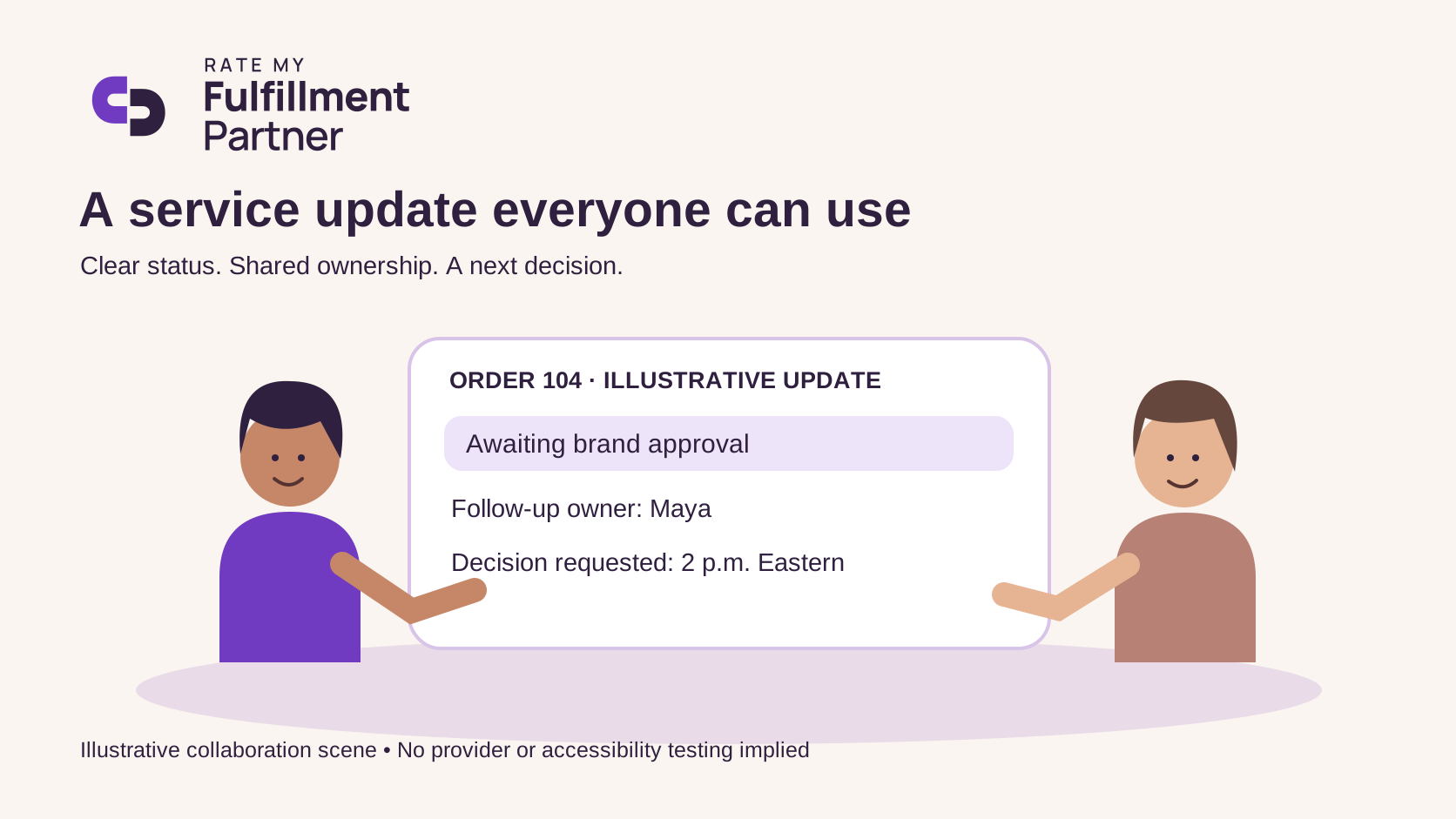
The second format improves readability but still leaves urgency unclear. The third can say: “Order 104 is awaiting packaging approval. Maya owns the warehouse follow-up. Brand approval is needed by 2 p.m. Eastern to enter today's planned packing run.” These names, order number and timing are illustrative, not a service commitment.
That wording identifies a requested decision without promising shipment. If approval arrives late, the update should state the next review point instead of silently keeping the old deadline.
Preserve structure when reports travel
W3C's table tutorial explains that accessible HTML tables need meaningful relationships between headers and data cells, and notes that table structure can be lost during format conversion. A visually tidy screenshot cannot demonstrate those relationships.
For a portal, ask whether the actual table has appropriate headers and can be used with the tools your team needs. For an export, ask to review the exported file itself. A well-structured portal is not proof that its PDF or email attachment preserves the same usability. A short text summary can help, but should not omit affected-order detail that the reader needs to act.
Agree what support will maintain
Put the reporting format, status definitions and escalation owner into the operating handover. Ask who corrects an inaccessible or incomplete report and what alternative is available while it is fixed. Keep sensitive customer details limited to people who need them.
Review one real update together after onboarding. Can the intended reader identify the issue, find the affected orders, understand their responsibility and locate the next decision time? Record the gaps and agree changes. This small review is a service-quality check, not a substitute for a formal accessibility assessment. It gives both teams a concrete way to improve communication before an urgent incident makes the gaps expensive.
Further reading
Use our 3PL selection guide to frame your shortlist and fulfillment pricing guide to compare the agreed scope.
Sources
Research accessed 2026-11-14.
- https://www.w3.org/WAI/WCAG22/Understanding/use-of-color.html
- https://www.w3.org/WAI/tutorials/tables/
Research method and limitations
Constructed three fictional report formats and inspected each against explicit state, owner and decision-time criteria. Applied W3C guidance to a proposed buyer review, not a live accessibility audit. No user testing, assistive-technology testing or provider accessibility assessment. Three illustrative formats are not a market sample; checklist cannot establish WCAG conformance. No firsthand provider testing, interviews or outreach occurred.