
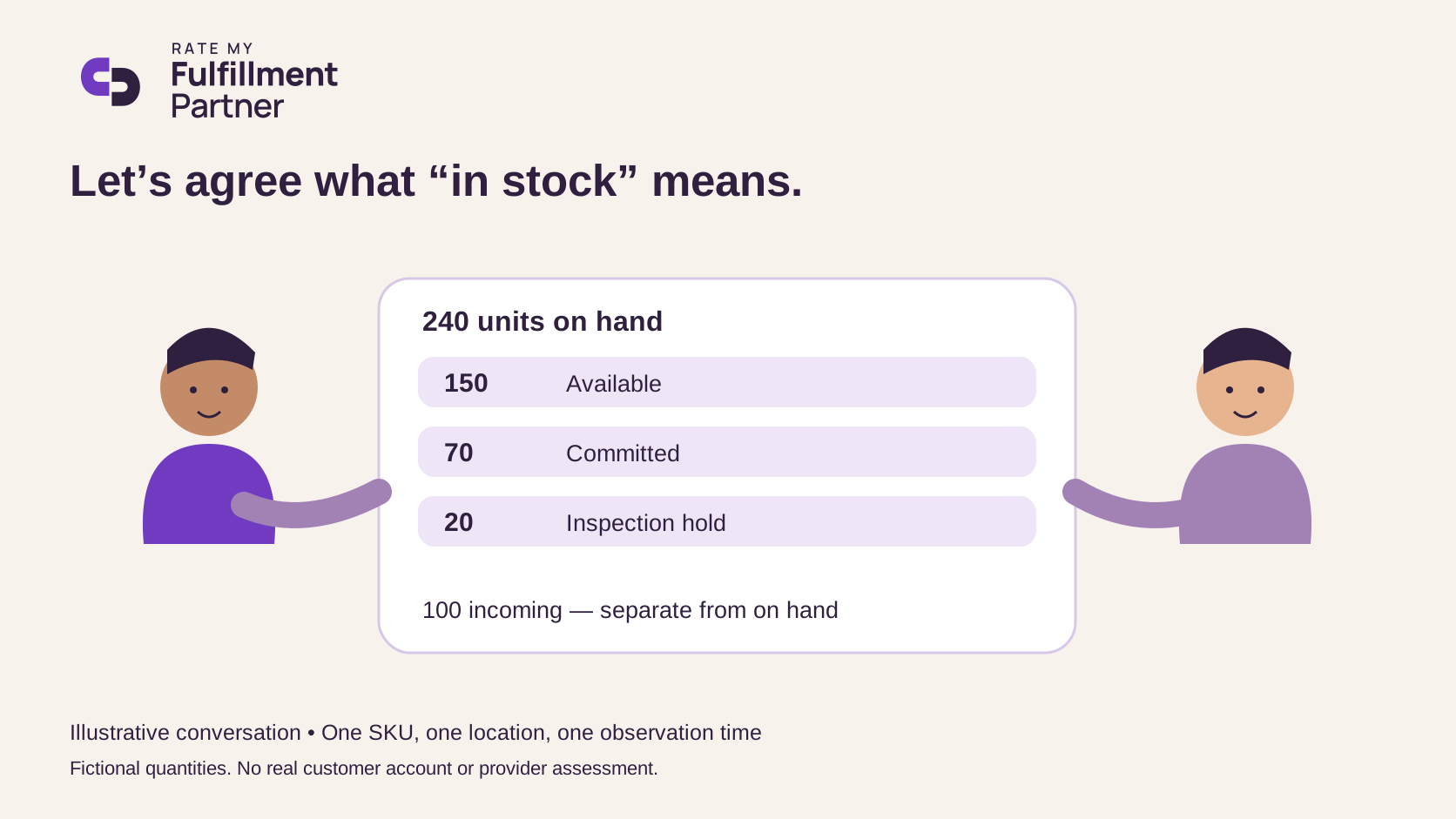
“We have 240 in stock” sounds like an answer. It can also be the beginning of a misunderstanding. Your account manager might mean everything physically present, while your customer-service team hears “240 ready for new orders.”
You do not need to become a warehouse-system expert to resolve this. You need a shared set of words and a small amount of context attached to the number.
Start with one agreed definition
In Shopify's documented model, on-hand inventory includes available, committed and unavailable units. Incoming inventory is a separate state. Those labels give Shopify users a reference point; another system's labels and mappings still need checking.
The practical request is simple: “When you use ‘in stock’ in an email, please tell us whether you mean on hand or available for new orders.” That question avoids accusing anyone of sending the wrong number before you know what the number means.
Reconcile a fictional update together
Imagine a single SKU at one location at 10 a.m. The warehouse reports 240 units on hand: 70 committed to existing orders, 20 held for inspection and 150 available. Another 100 are incoming. These are invented quantities for a communication exercise.
The reconciliation is 70 + 20 + 150 = 240. The incoming 100 are not added to that physical on-hand total. Whether and when they can become available depends on receipt and the agreed release process.
A weak message says, “Stock looks fine; another 100 are coming.” A clearer version says:
> Illustrative update: At 10 a.m., location A has 150 units available for new orders. Another 70 are committed and 20 are on inspection hold. We expect a separate inbound shipment of 100, but have not confirmed its release to available stock. We will update the held quantity after the inspection decision.
This version gives customer service something usable without promising a receipt date or inventing a resolution time.
Ask what changed before asking who is wrong
Suppose your storefront shows 145 available at 10:07. A seven-minute gap may matter. Five new commitments, a different location filter or an integration delay are possibilities to investigate, not explanations to assume.
Ask for the two observation times and the intervening transactions. Avoid averaging the figures or choosing the higher number because it looks more useful. Until the discrepancy is understood, agree which source governs customer promises and who owns the investigation.
The relationship improves when both teams can say, “These reports may be answering different questions,” and then check them together.
Agree on a short stock-update format
For recurring exceptions, request five fields: SKU and unit of measure; location; observation time and timezone; available, committed and held quantities; and the next decision or check. Keep incoming stock separate, with its own uncertainty.
Use explicit units. A count of 20 cases and a count of 20 individual products cannot be compared safely without a verified pack quantity. Likewise, stock across three warehouses may not all be usable for the order being discussed.
For held inventory, ask about the release decision rather than simply requesting “more stock.” Who approves it? What evidence is missing? When will the team next report progress? A named next check is more helpful than a hopeful “soon.”
Keep the vocabulary small enough to use
Start with the few states that cause actual confusion in your business. Put the agreed meanings into the account's working notes and review one real discrepancy together at the next service meeting. This article's reconciliation is a proposed conversation tool, not a provider audit or evidence of a particular system's configuration.
A good partner does not need to answer every inventory question instantly. It should help you understand what a number represents, what remains uncertain and what happens next.
Related reading
- How to raise a fulfillment issue that gets a useful answer
- Meet the people who will handle your difficult days
Sources
- Shopify: Inventory states — accessed November 4, 2026.