
A customer asks for a parcel to be taken to a reception desk instead of left at a side entrance. Your support team adds a note and replies, “Updated.” The customer naturally hears a promise about the delivery. The team may only have changed an internal case.
When reviewing a fulfillment partner, test how it handles delivery access instructions. These are often small requests with an outsized effect on trust. The relationship works better when everyone uses the same words for recorded, submitted and confirmed.
Establish which channel can carry the request
UPS's U.S. delivery-change guidance describes recipient options through tracking and UPS My Choice, including delivery instructions for eligible shipments. Availability can depend on shipment restrictions and status. This is a documented carrier channel, not proof that a note sent to a warehouse will automatically appear there.
Ask your 3PL what happens to instructions received before dispatch and after dispatch. Establish who checks eligibility and whether the customer needs to use the carrier's own channel. Avoid promising that a requested location, access arrangement or change will be honored before the relevant process supports that statement.
Use a four-state conversation test
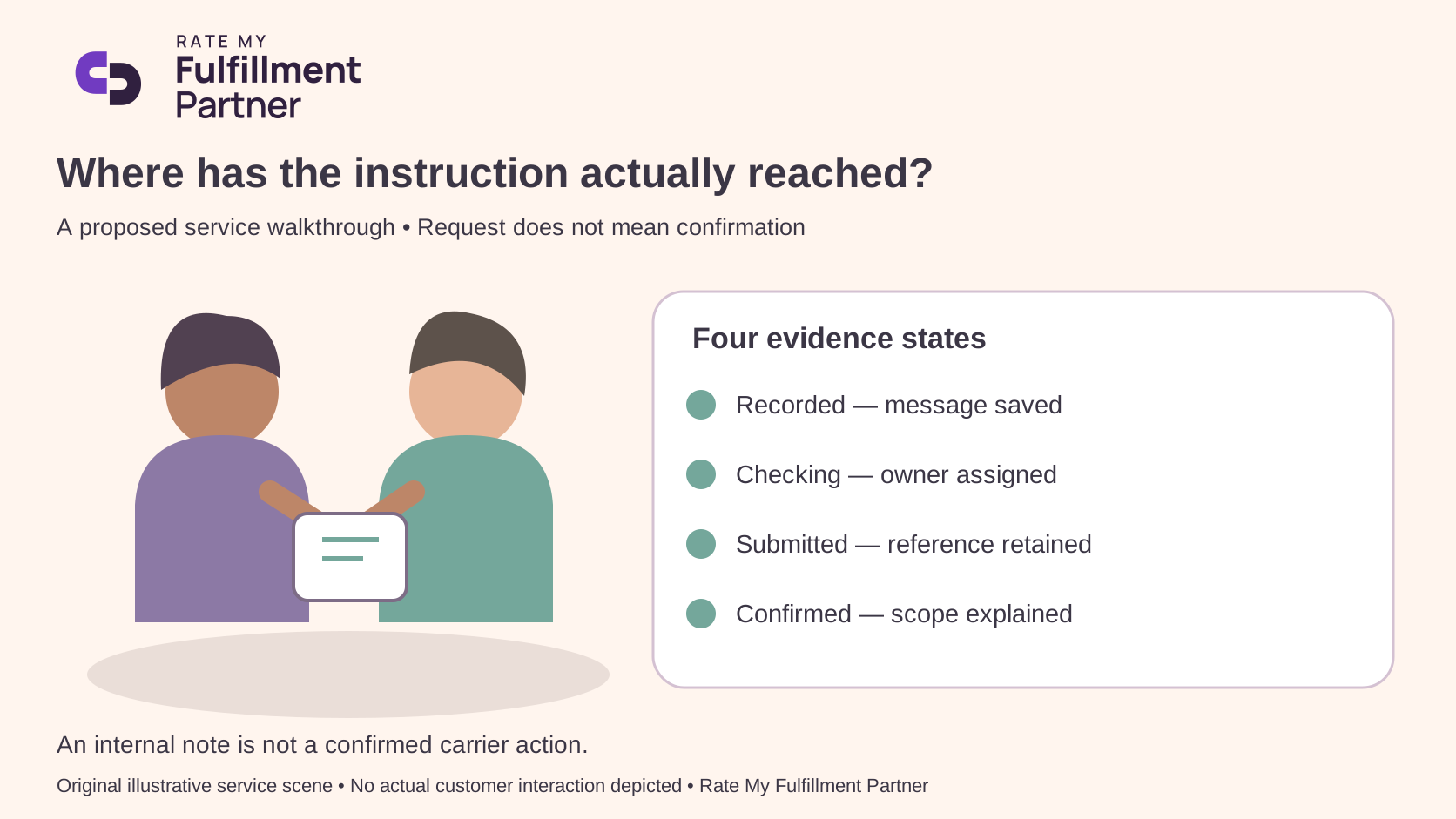
Our proposed desk exercise follows one fictional reception-desk request through four states. No carrier transaction was submitted and no provider was tested.
| Evidence held by support | Accurate customer update |
|---|---|
| Customer message saved | We have recorded your request. |
| Assigned owner checking the shipment | We are checking how this can be submitted. |
| Submission reference retained | The request has been submitted; the delivery outcome is not yet confirmed. |
| Carrier response or completed event | Explain exactly what the response confirms, including any remaining conditions. |
The exercise identifies three handoffs where a team could accidentally overstate progress. A single “done” status hides those distinctions. The remedy is a short evidence field, not necessarily a new software system.
Keep sensitive instructions out of broad circulation
An entry code should reach only the people or systems that need it for the agreed purpose. Do not paste it into a widely shared service-review deck simply to prove that the ticket was handled. Ask which approved channel carries the instruction, how the team corrects an error and where the customer should send an update.
This is an operational recommendation, not a claim that one retention period or transmission method fits every business. Follow your organization's approved privacy and security process.
Close the loop without promising an outcome you cannot control
Give the customer a named contact or team and a realistic next-update time. If the requested option is unavailable, say so clearly and explain the available next step. Do not repeatedly route the customer between the warehouse and carrier without recording what each party has already checked.
During onboarding, have the account manager read back the four-state example. Listen for the point where ownership transfers and the evidence that comes back. A helpful partner can distinguish a customer request, an internal action and a confirmed external result without making the customer decipher the systems involved.
Related reading
Sources
- Primary source 1 — accessed November 13, 2026.