
Start with the question the customer is asking
A customer who receives a broken item wants to know how the brand will put things right. A request for photographs may be necessary, but it should move that decision forward. It should not become an unexplained series of requests from the brand, warehouse and carrier.
Before peak season, sit down with your fulfillment partner and separate three jobs: deciding the customer remedy, investigating the packing issue and supporting any transportation claim. The evidence needed for one job may not be identical to the evidence needed for another. Agree who coordinates the request so the customer does not have to reconstruct that distinction.
Review the request for relevance
The FTC’s business guidance recommends keeping only personal information needed for a legitimate business purpose and limiting access. That principle is useful when designing a support workflow. It is not a carrier-specific claims rule or a universal retention period.
We reviewed three fictional request designs against decision relevance, customer effort and unnecessary exposure. No customer trial or provider performance evaluation was conducted.
| Request design | What it helps decide | What needs attention |
|---|---|---|
| Photograph the whole room and forward every order email | The purpose is unclear | Unrelated people, addresses or correspondence may be included |
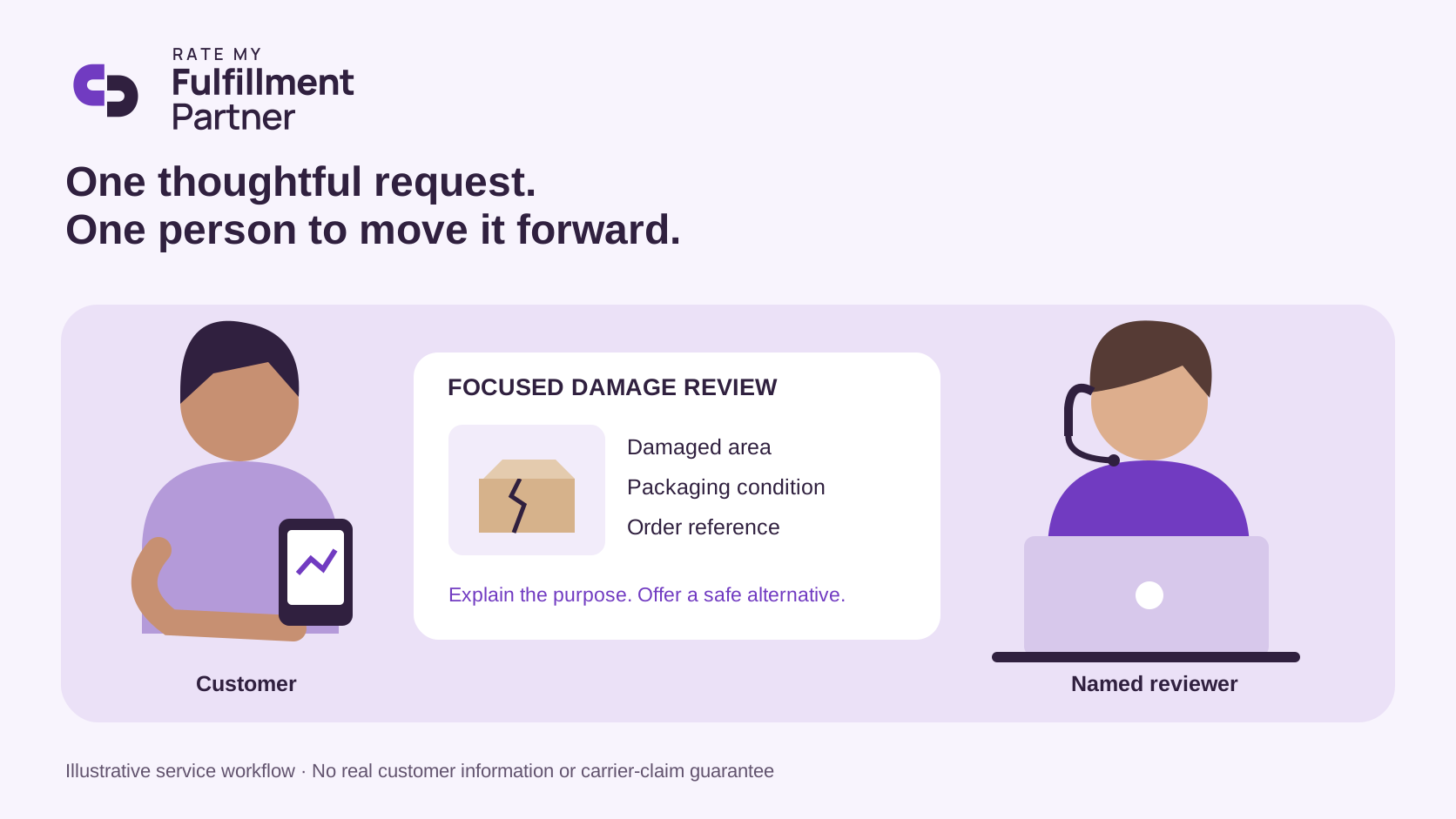
| Show the damaged area and packaging condition, linked to an order reference | Helps a reviewer understand the reported condition | Specify the approved channel and who reviews it |
| Customer cannot safely photograph or no longer has the packaging | Explains a missing evidence item | Give a named reviewer an alternate path; do not promise claim acceptance |
The targeted request is easier to explain because each item has a purpose. That is an editorial judgment about the request, not proof that it satisfies a particular carrier or improves recovery rates.
Give the customer a usable message
An illustrative message might say: “Please send a clear view of the damaged area and the packaging through this support link, with your order reference. These help our team review the condition and the packing. If taking the photos is unsafe or you no longer have the packaging, tell us so we can review the next step.”
Adapt the message to the actual product and evidence requirements. Do not ask someone to handle broken glass, leaking material or another hazardous item merely to complete a photo checklist. Have the appropriate team define a safe alternative for those cases.
If a label image is genuinely needed, say why. Avoid casually forwarding it to a broad internal group. Keep the connection between the customer’s order and the investigation available to the people doing the work, with access and retention handled under your approved policy.
Stop the second request before it starts
The first reviewer should record what has arrived, what is missing and whether the missing item changes a decision. Before requesting more, the warehouse contact should check that record. A photo already held in one approved system should not be requested again merely because a second team has not looked for it.
Set a next-update time and distinguish a customer remedy from a pending claim. Your service policy may allow a remedy before the transportation investigation ends; confirm the actual authority rather than assuming that it does.
Use the workflow when comparing partners
Ask a prospective 3PL to walk through a redacted damage case and show the handoff between support and operations. Look for a clear evidence purpose, a responsible reviewer and an exception path. Keep unanswered questions visible. A considerate process gives the customer a comprehensible next step while still giving the investigation useful information.
Further reading
Sources
- FTC: Protecting Personal Information — accessed 2026-11-01.