
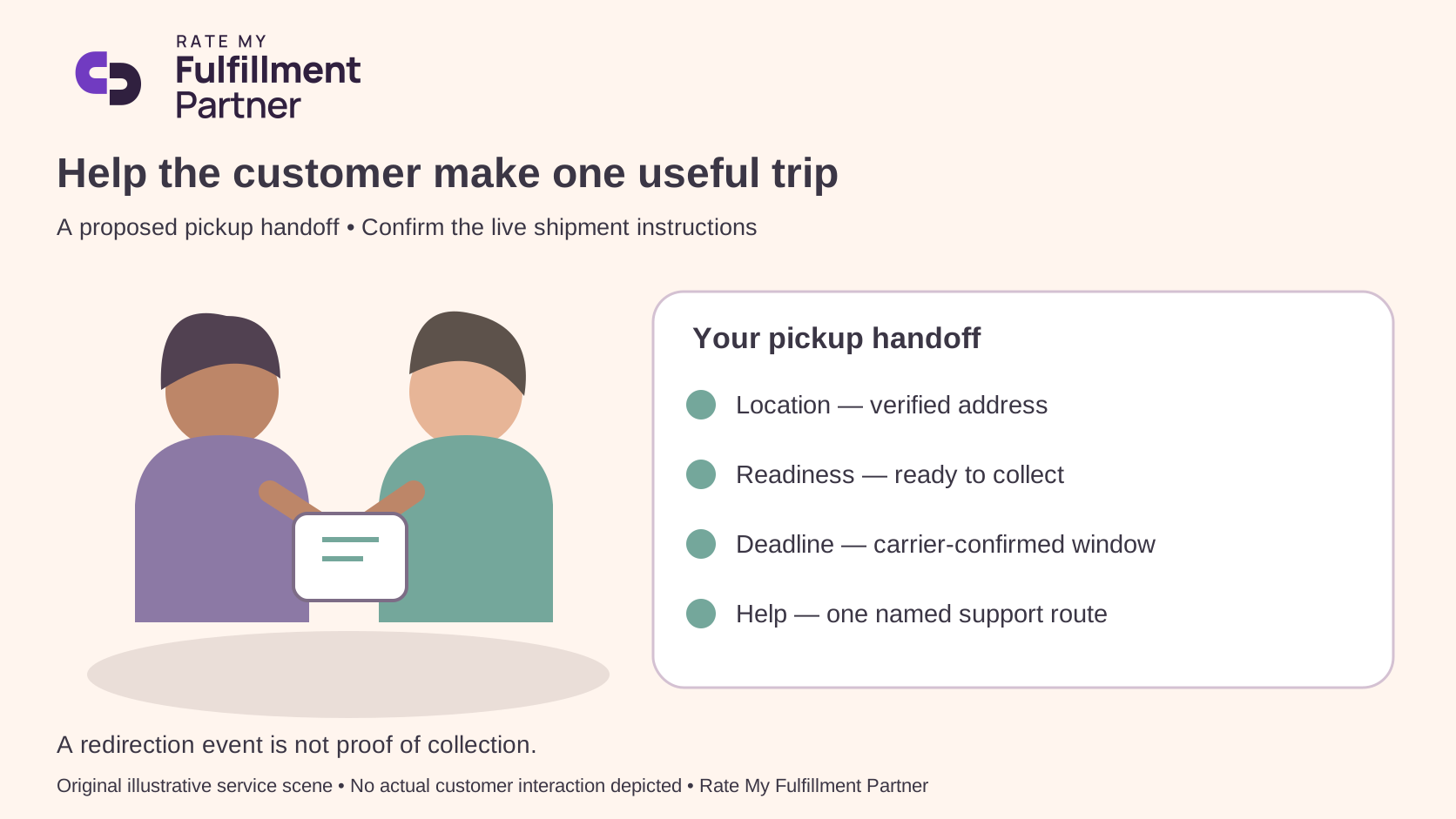
Your customer expected a parcel at home. Now the tracking page mentions a pickup location. They may be willing to collect it, but an automatic “your order has shipped” message does not answer where to go, whether the parcel is there or how long they have.
This is a useful service-quality test when choosing a fulfillment partner. Ask how the provider’s tracking events reach your support team and who owns the conversation when the delivery method changes after dispatch.
Verify readiness before sending someone out
UPS’s U.S. delivery-notice guidance says a redirected package may be held at a UPS Access Point for seven calendar days before return to sender. It tells recipients to confirm the location and the “Awaiting Customer Pickup” status before visiting. These are UPS-specific instructions, not a rule for every carrier or pickup network.
Use the live shipment instructions to confirm the actual collection window and identification requirements. Do not calculate a deadline from the order date or assume that the first failed attempt started the holding period. If tracking does not establish the deadline, ask for clarification rather than manufacturing a precise date.
Put the missing information in one message
We developed a proposed four-field handoff for a support walkthrough: verified location, readiness, collection deadline and a named route for help. The field names are our service recommendation; they are not evidence that a particular 3PL provides them.
| Case in the walkthrough | Customer-facing action |
|---|---|
| Redirection shown, readiness unclear | Explain that collection availability is being checked |
| Ready at a verified location | Give the location and current carrier instructions |
| Customer says they cannot collect | Assign an owner to investigate permitted alternatives |
| Return movement appears | Explain the next investigation step; do not repeat pickup advice |
The four cases expose different gaps. A template can contain the right address but still send someone too early. A readiness event can arrive after an old message has already gone out. A customer who cannot travel needs a decision, not another reminder.
Agree the boundary between brand and 3PL
The brand should decide the customer remedy under its policy. The 3PL may hold the shipping account or the carrier contact needed to investigate options. Confirm that arrangement before relying on it, including support hours and where the outcome will be recorded.
Ask the provider to demonstrate what it sends when tracking changes and whether your team can distinguish a customer request from a confirmed carrier action. “We asked for redelivery” should not become “redelivery is booked” without supporting confirmation.
Close the case on the right outcome
Our proposed closeout check asks whether the customer collected the parcel, another permitted arrangement completed, or the brand resolved a return or replacement. A reminder sent is an activity, not proof of any of those outcomes.
During a service review, sample these cases separately from ordinary home deliveries. Record missing fields and unnecessary customer effort without assuming that every uncollected parcel was the warehouse’s fault. The goal is a clearer handoff: the customer knows what is possible, the team knows who is acting, and an old shipping notification no longer carries the whole conversation.
Related reading
Sources
- UPS: Delivery Notice — accessed November 12, 2026.